

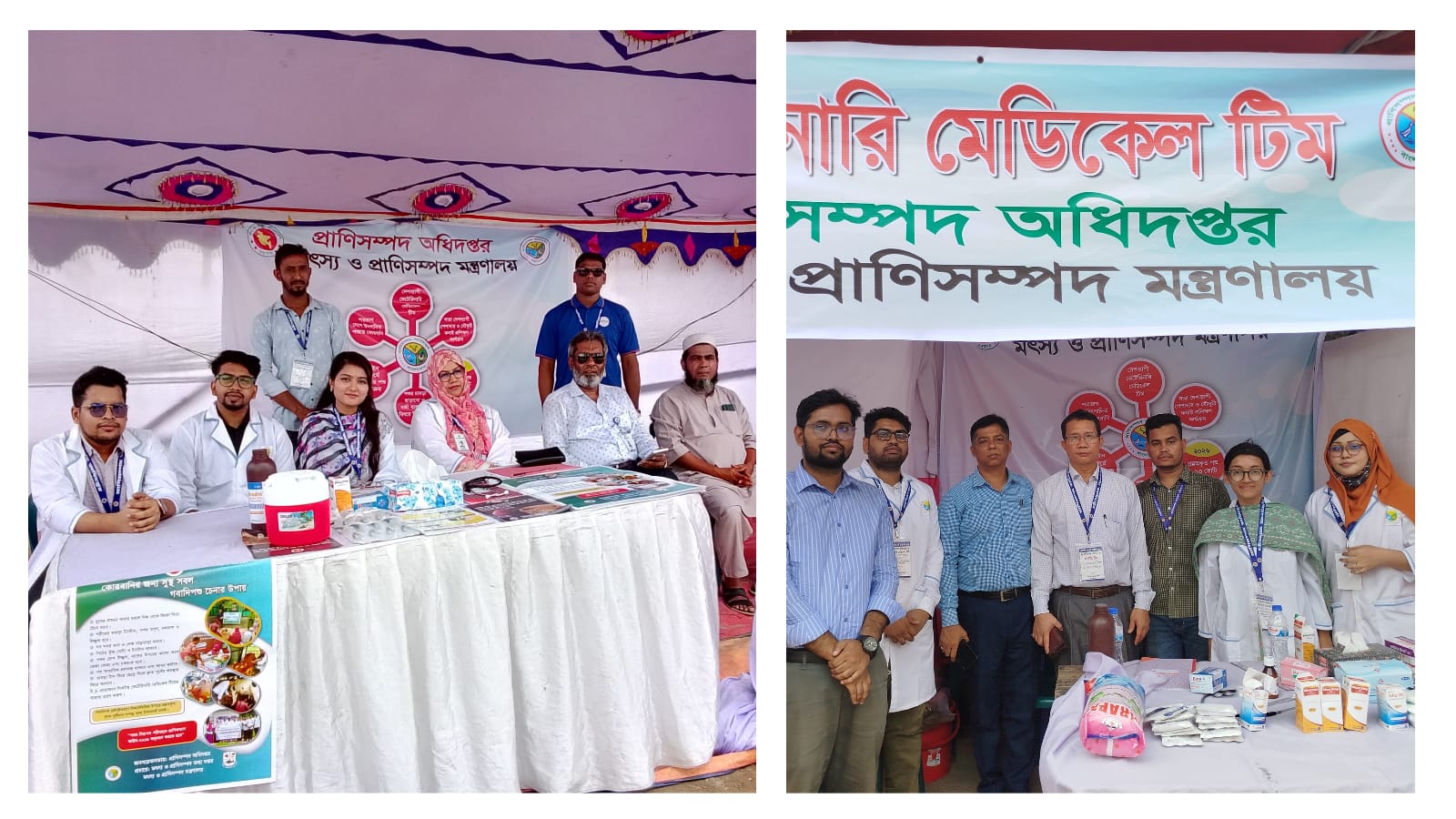
To ensure the health and safety of sacrificial animals, the Ministry of Fisheries and Livestock’s Department of Livestock Services (DLS) has set up complimentary veterinary medical camps at 29 Qurbani haats in the capital.
The initiative is supported by 87 veterinary interns hailing from Sher-e-Bangla Agricultural University (SAU), Gono University, and Bangladesh Agricultural University (BAU). These students are working inside the markets alongside senior veterinary specialists and duty officers to provide on-the-spot mobile medical assistance.
Running from Saturday (May 23) to May 26, the four-day campaign operates daily between 9:00am and 6:00pm. The medical setups are distributed across the city, covering 18 markets in the Dhaka North City Corporation and 11 markets in the Dhaka South City Corporation to provide health screenings, emergency aid, and necessary treatments.
According to Dr. Md. Saifullah Mahmud, the veterinarian heading the team at Dhaka South City Corporation’s Market No. 11, the medical teams focus on evidence-based, safe, and alternative treatments to avoid the over-reliance on antibiotics. This method, he stated, protects the animals, prevents infections, safeguards community health, and minimizes ecological damage. He emphasized that this coordinated strategy aligns with livestock directives to promote the One Health principle, which links human, animal, and environmental welfare.
Mahira Binta Alam, a Gono University student working as an intern veterinarian, highlighted the educational value of the program, stating that it provides crucial field experience in diagnosing illnesses, implementing preventative measures, and delivering correct medical care. He added that advising farmers on preserving animal health and managing markets effectively helps build vital professional skills for the future.
Echoing similar sentiments, Mahmud Hasan, a fellow BAU student and intern deployed at Dhaka North City Corporation’s Market No. 2, pointed out that many animals experience stress or minor wounds during transit. The teams conduct rapid physical assessments, dress injuries, advise the separation of vulnerable animals, and provide home-care instructions to owners. This approach controls disease spread and ensures a more secure environment for both traders and buyers.
Dr. Md. Shafiqur Rahman, an officer from the central coordination team, stated that the primary objective of these teams is the protection of community and livestock health at the seasonal markets. He noted that each location is fully stocked with emergency tools, medicines, and informational literature. While the teams work from morning until evening, their operations will be intensified to provide rapid emergency responses during the peak days of Qurbani.
Detailing the scope of the program, Md. Shahzaman Khan, the Acting Director General of the DLS, stated that the services include free physical check-ups, wound care, immediate treatment for infectious diseases, and vaccinations or vaccination advisories. Livestock owners are guided on sanitation standards and isolation procedures when necessary. Furthermore, the DLS is distributing leaflets and posters detailing the Animal Welfare Act–2019, guidelines for transporting Qurbani livestock, advice against buying sick or artificially fattened animals, and best practices for safe livestock trade.
With the massive arrival of cattle during the festive period increasing the potential for disease transmission, DLS officials noted that district and upazila administrations, alongside the livestock department, are prioritizing these interventions. Officials confirmed that the veterinary teams will maintain their morning-to-evening shifts throughout the four-day schedule, expanding their reach and scaling up activities during the main days of Qurbani.